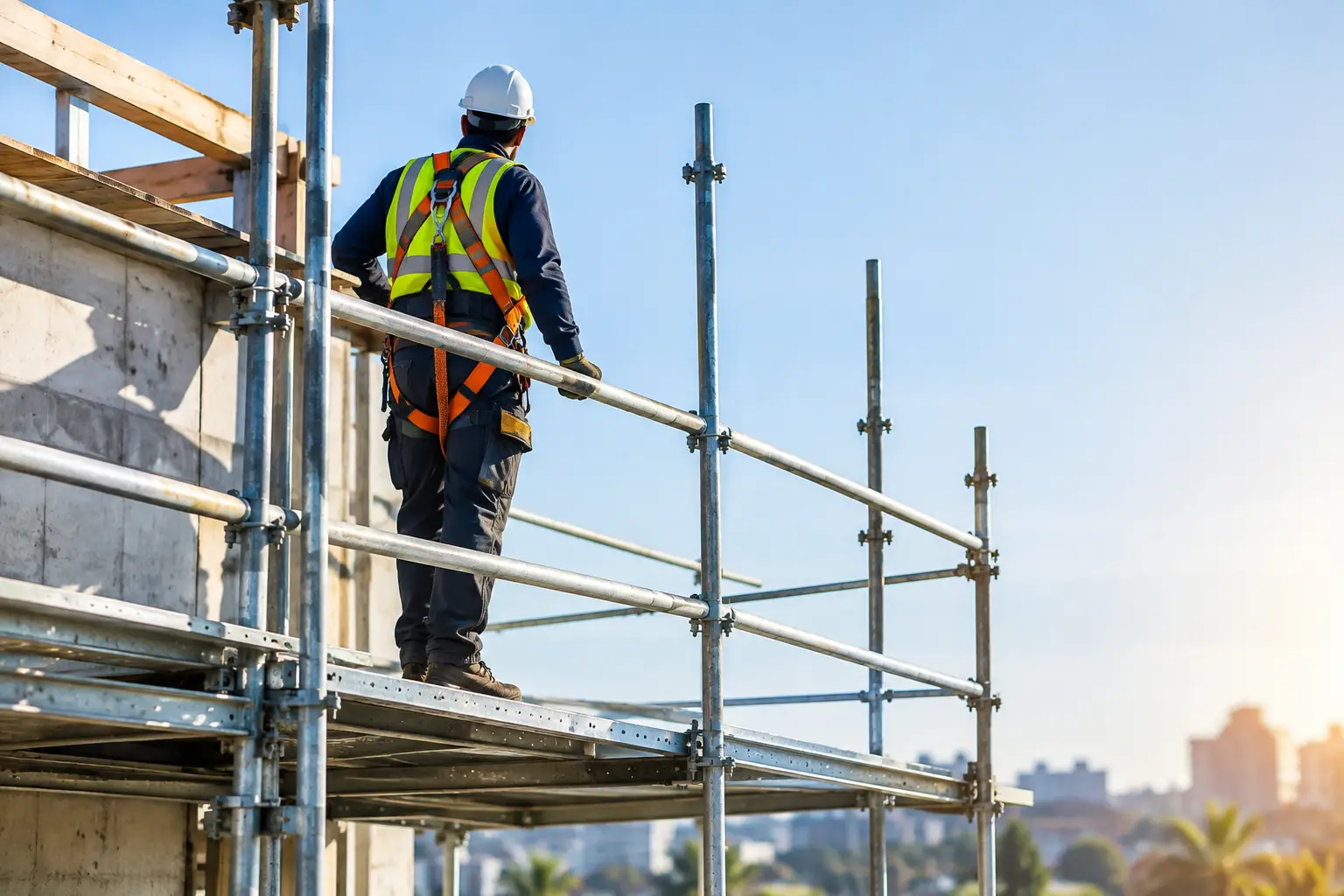
A scaffold fall rarely begins at the moment a worker loses balance. It usually starts earlier: an incomplete handover, an improvised access point, a missing guardrail, overloaded decking, or a change in site conditions that nobody assessed. On active construction projects, these small gaps can quickly become serious incidents.
Knowing how to prevent scaffold falls requires more than supplying a compliant scaffold system. It requires planning, correct erection, documented inspection, competent supervision, and a site culture that stops unsafe work before a person steps onto the platform. For contractors managing multiple trades, changing work fronts, and schedule pressure, every one of those controls matters.
Start With the Right Scaffold Design
Fall prevention begins before equipment arrives on site. The scaffold must suit the intended task, loading requirement, work height, façade geometry, access route, and duration of use. A system selected only for available inventory can create avoidable modifications later, particularly around corners, setbacks, slab edges, mechanical penetrations, and uneven ground.
Define the work activity clearly during planning. Painting, cladding installation, blockwork, concrete repair, and MEP access do not place the same demands on a scaffold. The expected number of workers, material loads, tools, waste handling, and need for public protection should all inform the design.
The foundation is equally critical. Base plates, sole boards where required, and properly prepared ground distribute loads and help prevent settlement. A scaffold that is initially level can become unstable when placed on soft fill, poorly compacted ground, wet soil, or surfaces affected by vehicle movement. On suspended or elevated structures, verify the supporting structure has the capacity for the proposed scaffold loads.
A qualified scaffold provider can help contractors select a configuration that reduces field alterations. This is especially valuable on complex UAE projects, where high-rise access, heat, wind exposure, and crowded work zones often affect scaffold planning.
How to Prevent Scaffold Falls During Erection
Erection and dismantling are high-risk activities because the scaffold is not yet fully protected. The sequence of assembly must be defined by the system manufacturer, project design, and applicable site requirements. Workers should not rely on improvised methods to reach the next lift or install components from an unprotected position.
Use competent, trained scaffold erectors under appropriate supervision. They need to understand the specific system being assembled, including standards, ledgers, braces, transoms, ties, deck units, guardrail components, and access arrangements. Components from different systems should not be mixed unless their compatibility and design use have been confirmed.
Collective protection should be installed as early as the erection sequence allows. Advanced guardrail methods, where suitable for the system, can protect erectors before they access an exposed platform. Where collective protection cannot be maintained, a planned personal fall protection method may be necessary. That method must identify suitable anchorage points, compatible harness and lanyard equipment, clearance requirements, and rescue arrangements. A harness alone is not a fall prevention plan.
Do not allow partial scaffold sections to be used by other trades. Barricade unfinished areas, communicate their status, and control access until the scaffold has been inspected and released for use.
Provide Complete Edge Protection and Safe Access
A working platform is only as safe as its edges and access points. Open sides and ends require the appropriate guardrail system, including top rails, midrails, and toe boards or equivalent protection required by the project standard. Toe boards help reduce the risk of tools and materials falling onto people below, but they also help prevent a worker's foot from slipping off the platform edge.
Platforms should be fully decked for the intended work area, properly supported, and secured against uplift or movement where the system requires it. Gaps must be controlled. A small gap may be acceptable only when it is necessary for the work and managed under the applicable safety requirements; a wide or unplanned gap is an immediate fall hazard.
Safe access is often where otherwise well-built scaffolds fail in practice. Workers should reach each lift by designated stair towers, stair units, ladders, or access bays designed for the scaffold system. Climbing cross braces, guardrails, frames, or exterior standards is prohibited because these components are not intended as climbing routes.
Access openings must be protected. Self-closing gates, protected ladder openings, or other approved arrangements prevent workers from stepping backward into an unguarded opening. Keep access routes clear of stored materials, hoses, electrical leads, and waste. If a worker has to climb over materials to enter a platform, the platform is not being managed safely.
Inspect, Tag, and Reinspect the Scaffold
A scaffold can be compliant at handover and unsafe several days later. Other trades may remove a guardrail for material access, a delivery may strike a standard, rain may affect the base, or wind may loosen sheeting and change loading conditions. Regular inspection is therefore an operating control, not paperwork.
A competent person should inspect the scaffold after erection, before initial use, at required intervals, and after any event that could affect its integrity. That includes alteration, impact, severe weather, prolonged inactivity, unauthorized modification, or visible settlement. The inspection should address foundation condition, vertical and horizontal alignment, ties, bracing, platforms, guardrails, access, component damage, and housekeeping.
A clear tagging or status system helps every trade understand whether the scaffold is approved, restricted, incomplete, or prohibited from use. The tag does not replace inspection, but it makes the inspection result visible at the point of access. Site teams should know that a missing, unclear, or out-of-date status tag is a reason to stop and report the condition.
If an issue is found, isolate the affected area immediately. Do not expect workers to remember verbal warnings across shifts. Physical barriers, updated status identification, and prompt corrective work are more reliable controls.
Control Alterations and Material Loading
Unauthorized alteration is one of the most common causes of scaffold fall exposure. A worker may remove a guardrail to lift materials, shift a deck to create a clearance, or detach a tie that appears to interfere with a task. Each change can affect both edge protection and structural stability.
Only authorized personnel should alter a scaffold. Supervisors need a practical process for requesting changes so trades do not feel forced to improvise when site conditions change. The revised area should be reinspected before it returns to service.
Material storage needs the same discipline. Every platform has a loading limit, and that limit includes workers, tools, stored materials, and temporary waste. Do not concentrate masonry units, boards, or equipment in one area simply because there is open deck space. Distribute loads as designed, remove waste routinely, and keep materials away from platform edges and access openings.
Consider the effect of wind on materials, debris netting, shrink wrap, banners, and temporary enclosures. These additions can substantially increase wind loading. They should be included in the scaffold design rather than added after erection without review.
Train Workers to Recognize Changing Conditions
Workers do not need to be scaffold designers to prevent falls. They do need enough training to recognize unsafe access, incomplete platforms, missing edge protection, excessive loading, damaged components, and changing weather conditions. They must also know who to contact and have confidence that reporting a problem will not be treated as a delay tactic.
Toolbox talks are most effective when they address the work happening that week. Before façade work starts, focus on access, material handling, and dropped-object controls. Before a forecast period of high wind or rain, address weather response and the need to stop work when conditions exceed the safe operating plan. Repeating broad messages without connecting them to the current task often leads to complacency.
Supervisors should also watch for behavioral warning signs: workers bypassing an access tower to save time, carrying loads that prevent three-point contact on ladders, standing on materials to gain height, or removing rails to improve reach. These are not minor shortcuts. They indicate that the scaffold arrangement may no longer support the work efficiently or safely.
Plan for Weather, Rescue, and Work Coordination
Weather can change scaffold conditions quickly. Wind may affect balance, loose materials, and enclosure systems. Rain can make decks and ladders slippery, while extreme heat can reduce concentration and increase fatigue. Establish practical stop-work criteria and make sure supervisors can enforce them without uncertainty.
A fall arrest system, if used, must be supported by a rescue plan. Suspension trauma can become a serious concern when a fallen worker remains suspended while the team waits for help. Identify who will initiate rescue, what equipment is available, how emergency services will gain access, and whether the rescue method works at the actual scaffold height and location.
Finally, coordinate scaffold use between trades. A scaffold supporting concrete repair may later be used for glazing, electrical work, and finishing activities. Each trade can introduce different loads, access demands, and modifications. Daily coordination between the site team, scaffold supervisor, and rental partner keeps the structure aligned with the work rather than allowing risk to accumulate unnoticed.
Safe scaffold work is not created by a single inspection or a single rule. It is maintained through disciplined decisions at every stage, from equipment selection to the final dismantling shift. When the planned scaffold matches the work, workers have protected access, and changes are controlled, fall prevention becomes a practical part of reliable project delivery.