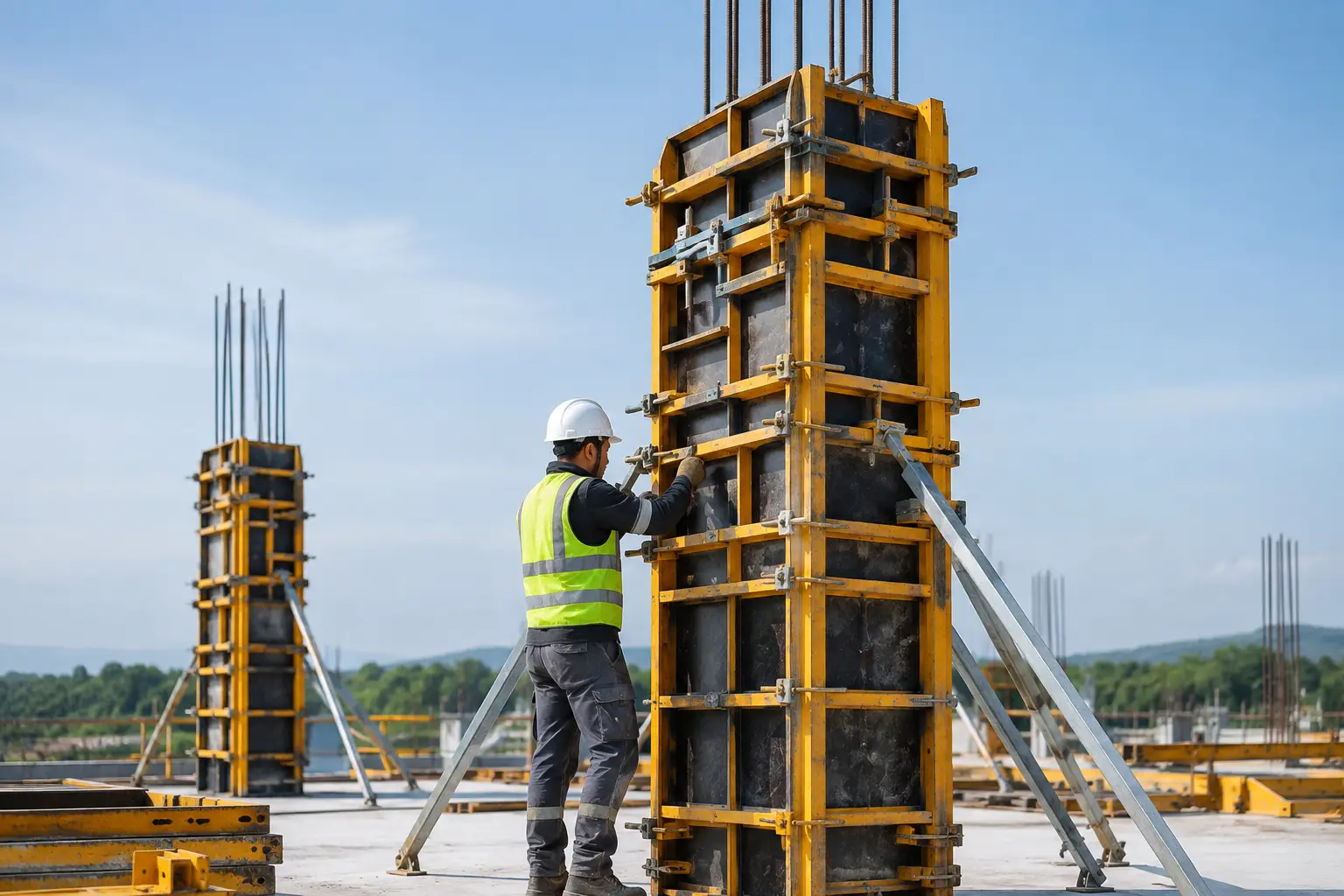
A column pour can look straightforward on a drawing, but the site conditions behind it rarely are. Formwork rental for concrete columns gives contractors a practical way to match forming capacity to the actual pour sequence, column geometry, access constraints, and stripping schedule without committing capital to equipment that may sit idle after the structure is complete.
For project managers and site engineers, the objective is not simply to enclose fresh concrete. The selected system must maintain line, level, plumb, and surface quality while carrying the anticipated concrete pressure. It also has to be erected, inspected, poured, and stripped safely within the planned work cycle. Rental is most effective when those requirements are defined before equipment reaches the project.
What Column Formwork Must Control
Concrete columns place concentrated demands on formwork. Unlike a large wall pour, a column has relatively small dimensions but can develop significant lateral pressure when concrete is placed quickly, has high workability, or includes admixtures that delay setting. Poorly selected panels, inadequate clamps, or incorrect tie spacing can lead to movement, grout loss, honeycombing, and in serious cases, formwork failure.
A suitable column formwork arrangement controls four operational issues: concrete pressure, dimensional accuracy, surface finish, and safe access. The form face must remain stable under load. Walers, clamps, ties, pins, and corner connections must transfer that load through the system without allowing the shutter to spread. The system must also permit adjustment so the crew can set the column accurately before the pour begins.
Surface requirements matter as well. Columns left exposed in lobbies, podiums, parking structures, and industrial facilities may require a more consistent finish than columns that will be concealed by cladding or plaster. Form-face condition, joint treatment, release-agent application, and the quality of sealing at corners all affect the final result.
When Formwork Rental for Concrete Columns Makes Sense
Rental is particularly useful when column sizes vary across a project, when the number of simultaneous pours changes by floor, or when the contractor needs additional capacity for a short period. A high-rise frame, for example, may require a repeatable cycle with a fixed number of column sets. A villa development or industrial project may instead need different configurations as the structural layout changes.
Owning equipment can be economical for contractors with sustained, predictable formwork demand and established maintenance resources. However, ownership also requires storage, transport, inspection, repair, cleaning, and replacement planning. Rental shifts much of that equipment-management burden away from the project team while allowing the formwork package to be sized for the current scope.
The strongest case for rental is not based on day rate alone. It is based on total project control. If the correct quantity is available when pours are planned, crews spend less time adapting unsuitable materials, and the project avoids purchasing equipment that does not fit the next job. That said, rental requires disciplined coordination. Late design changes, unplanned pour accelerations, and poor return management can increase cost if the equipment plan is not kept current.
Match the System to the Column Geometry
Square and rectangular columns can often be formed with modular panel systems, timber-faced panels, plywood with supporting walers, or purpose-built column boxes. The right choice depends on section size, repetition, finish specification, and lifting method. Adjustable column clamps can be efficient for a range of rectangular dimensions, while modular panels may offer better integration with wall-forming equipment already used on the site.
Circular, tapered, inclined, and heavily reinforced columns need earlier technical review. Circular columns may require steel circular forms or carefully selected curved components. Tapered sections and architectural profiles often need custom solutions. Where reinforcement congestion is high, the formwork must allow practical closing, vibration, and inspection without forcing the crew into unsafe or improvised work methods.
Do not assume that one form size will serve every column on a project. Review the structural drawings by type, not only by total quantity. Grouping columns into common dimensions and pour sequences gives the rental supplier a clear basis for configuring panels, clamps, ties, braces, and accessories.
Start With Pour Pressure, Not Panel Availability
A formwork package should be selected from engineering and operational inputs, not from what happens to be available in a yard. The supplier and project team need the column dimensions, intended pour height, concrete mix information, expected placement rate, and planned method of consolidation. These factors influence the pressure the formwork must resist.
Placement rate deserves particular attention. Fast placement can increase fresh-concrete pressure, especially with workable mixes. Pumped concrete, self-consolidating concrete, retarders, and hot-weather logistics can all change the behavior assumed in a basic setup. The crew should follow the approved pour rate rather than trying to recover lost time by filling columns faster than the formwork arrangement permits.
Bracing is equally important. Column forms need adequate support to remain plumb during setup and throughout the pour. Braces should be fixed to a suitable base or structural point, with adjustment available for final alignment. On suspended slabs, confirm that the support location and fixing method are acceptable for the imposed loads. Never treat bracing as an optional accessory added after the forms have been erected.
Plan Access and Inspection Before the Pour
Column formwork does not operate in isolation. The crew needs safe access to install reinforcement, close the shutters, place concrete, monitor the form, and strip the system. Depending on height and location, this may require independent scaffolding, working platforms, guardrails, ladders, or engineered access arrangements.
Before concrete placement, the responsible site team should verify that the formwork is clean, release agent is correctly applied, joints are sealed where required, ties and clamps are fully engaged, and braces are secure. Check dimensions, diagonals where relevant, and plumb. Confirm that embedded items, starter bars, sleeves, and openings are in position, because correcting them after the shutters are closed can delay the pour or compromise the formwork.
During placement, assign competent personnel to observe the form. They should watch for grout leakage, movement at corners, loosening clamps, brace displacement, and excessive vibration effects. If movement is observed, stop the pour and correct the condition. Continuing to place concrete into a shifting form is not a production decision - it is a safety and quality risk.
Define the Rental Scope Clearly
A complete rental package may include panels or column boxes, corners, clamps, ties, wing nuts, walers, braces, base plates, platforms, and connecting hardware. The exact scope should be documented before delivery. Small components are often the items that stop a pour when they are missing, damaged, or incompatible with another system on site.
Confirm the condition standard for form faces and structural components, along with delivery timing, off-hire procedures, cleaning responsibilities, and replacement charges for lost or damaged items. It is also useful to establish who will inspect the equipment on arrival and who has authority to report shortages before the material is distributed across the site.
Technical support adds value when the supplier reviews the intended configuration, quantities, sequencing, and access interfaces. Capital Access Scaffold Solutions can support this process by helping project teams align formwork and access equipment with planned concrete operations, rather than treating rental as a simple delivery transaction.
Control the Cycle From Erection to Return
The rental period is affected by more than concrete curing time. Include the time needed for delivery, erection, adjustment, inspection, pouring, stripping, cleaning, stacking, and collection. A form set that is technically adequate but held up by slow stripping or poor cleaning can disrupt the next cycle and create avoidable extension costs.
Stripping should follow the project engineer's requirements and the approved concrete-strength criteria. Do not release forms because the calendar suggests the concrete should be ready. Ambient temperature, mix design, curing conditions, and structural loading all affect stripping decisions. Once removed, forms should be cleaned promptly, checked for damage, and stored on stable ground so they can be reused safely or returned in acceptable condition.
Good formwork rental management is visible in the details: accurate quantity tracking, protected form faces, separated hardware, planned collection areas, and early communication when schedules move. These controls protect both the project budget and the next scheduled pour.
The best rental plan gives the field team a formwork system they can set accurately, inspect confidently, and cycle without unnecessary improvisation. Bring the supplier into the discussion while the pour sequence is still being planned, and the column package can support safer work, cleaner concrete, and more reliable progress on site.